Ongoing PhD projects
Latency, Misalignment
Isabella Forciniti
Digital vocal technologies do not simply process sound. They govern it. Pitch correction, temporal quantization, and AI voice synthesis encode normative ideas about what a voice should be — smooth, stable, correctly gendered — and enforce them automatically, at the millisecond scale, before any human listener makes a judgment. The result is a regime of vocal recognition: a set of invisible rules that determine whose voice qualifies as coherent, credible, and legitimate. Latency, Misalignment investigates that regime through performance. Working inside vocal correction systems rather than describing them from the outside, it develops artistic strategies that deliberately misapply alignment technologies — through drift, mismatched scale targets, recursive feedback, and latency — transforming correction into instability. That instability is not failure. It is the moment when the regime becomes visible: when what is normally enforced silently can be heard, felt, and contested. The research is rooted in practice. Encountering the resistance embedded within vocal software and preset architectures during the development of a commissioned live performance for Studio Dan’s 20th anniversary revealed a critical gap in existing scholarship. This experience revealed a gap in existing scholarship: although vocal norms have been widely discussed at a cultural level, far less attention has been given to how these norms are actively produced within the parameter logic of the software itself. This project names that level micro-chrononormativity, and proposes performance as the method capable of investigating it from the inside. The central output, The Vocal Infrastructure Interface, is a live performance site in which the researcher performs within automated, shifting alignment regimes in real time. The infrastructure is the co-performer; their negotiation is the work. By staging vocal coherence as a contingent and contested outcome rather than a natural given, the project contributes to artistic research, performance studies, and critical debates on algorithmic governance, digital embodiment, and the politics of the mediated voice.
Research focus: Musical Performance
Supervisors: Univ.-Prof. Dr. Christopher Williams; Univ.-Prof. Dr. Lucia D’Errico
Website: https://isabella.klingt.org/
New Self – Redefining the Role of the Musician through Embodied Actor and Dance Techniques
Gabriela Irzyk
This research project investigates the transformation of the classical musician from a traditional performer into a "total performer" through the adaptation of psychophysical methodologies from theatre and dance. Despite the increasing demand for musicians to participate in interdisciplinary and theatrical contexts, traditional music education remains largely hierarchical and focused on technical-interpretative mastery, often neglecting the body’s potential as a tool for emotional narrative and dramaturgical agency. This study explores how techniques such as Jerzy Grotowski’s (1968) via negativa, Rudolf Laban’s (1971) Effort Theory, and Michael Chekhov’s (1953) psychological gesture can be adapted to the specific physical constraints of instrumental play. The research employs an artistic research methodology, combining practice-based laboratory, collaborative workshops with students, and the creation of a new performance work based on the myth of Calypso. The goal is to bridge the gap between "technical execution" and "embodied presence," providing a set of practical tools that enhance a musician’s expressive range, mitigate performance-related stress, and redefine the musician’s role in contemporary performance art.
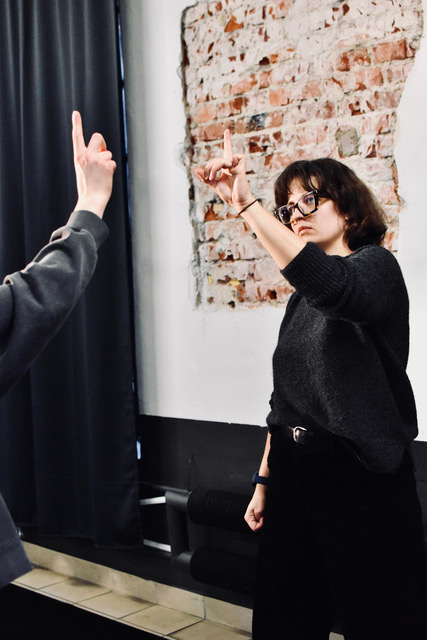
photo credit: Katarzyna Wietrzyk
Research focus: Musical Performance
Supervisors: Univ.-Prof. Dr. Lucia D’Errico; Univ.-Prof. Dr. Christopher Williams
THE SOUND HOUSE - Confronting the self, tracing the liminal: Investigating the auditory construction of home through sound installation
Chelsea Leventhal
This PhD project investigates how sound installation can address the complex, often contradictory experiences bound up in the idea of home and trace that which unfolds within the domestic realm. Sound installations are generally defined by the autonomy and free movement of the encounterer, who is invited to navigate a decentralized and intersensorial aesthetic experience. Such an encounter often begins with an initial moment of disorientation, from which the self re-emerges as a central and essential constituent of the work who is guided to an uncommon extent by the auditory. My inquiry considers how the conscious and unconscious layers of this response, which reveal themselves in time and are apperceptual in nature, might trace the fluctuating, fleeting, and often subliminal moments of emplacement and destabilization that characterize attempts at placemaking. The related works examine auditory experiences of domestic spaces, and moments in which sound plays a role that may often go unnoticed or be difficult to grasp. Merging the visual, tactile, and auditory, I seek to examine currents of longing and fear by merging reality and fantasy, the familiar and the unknown.
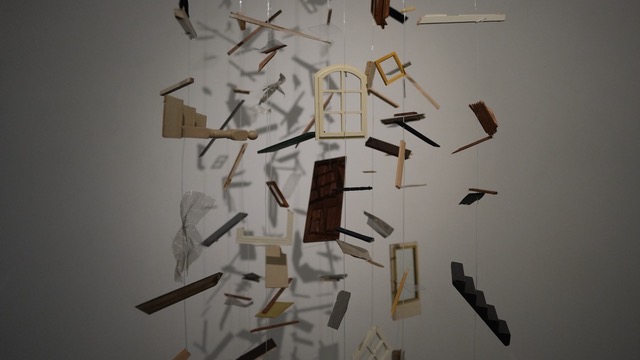
photo credit: Chelsea Leventhal
Research focus: Sound and Intermedia
Supervisors: Univ.-Prof. Dr. Hanns Holger; Univ.-Prof. Dr. Eckehard Pistrick
Website: https://www.chelsealeventhal.net
Probabilistic Sound Practices and Tuning Systems: A Sonic Archaeology of Marginality
Lucie Nezri
This project is a sonic archaeology that investigates how sonic materials and processes, specifically rational tuning systems and probabilistic algorithms, can be excavated, analyzed, and examined to trace histories and understand trends of knowledge production, destruction, and preservation of marginalized communities. This project goes beyond treating these materials and processes as inherited technical artifacts that are inanimate, but also aims to show that their reactivation has shaped and continues to shape contemporary sound practices. The project examines how these particular materials come into resonance with artistic practices in ways that are informed by, and thus can be used to examine, marginality: the human condition of lived experiences at the periphery of dominant cultural, social, or epistemic models (for instance, in relation to racialized, diasporic, or minority identities). It explores how probabilistic algorithms and tuning systems encode specific modes of perception, knowledge, and cultural positioning. In particular, the research investigates how alternative tuning systems, when embedded within probabilistic frameworks, can function as mediums to explore phenomenologies of marginality precisely because they probe the liminal thresholds of human perception and often destabilize conventional approaches to listening and performance. In this sense, tuning systems and probabilistic algorithms are understood not only as technical devices, but as carriers of practice that mediate relationships between sound, perception, and historically situated forms of subjectivity.
Research focus: Sound and Intermedia
Supervisors: Univ.-Prof. Dr. Michael Winter, Univ.-Prof. Dr. Eckehard Pistrick
Website: https://lucienezri.com/
Living Semiosis: Rediscovering Listening (Sense of Hearing ) as an Extraceptual Sense for Human and Non-Human Interrelationality
Martyna
Research focus: Sound and Intermedia
Supervisors: Univ.-Prof. Dr. Hanns Holger Rutz; Assoz. Prof. Dr. phil. Mag. Judith Laister
Transforming Anatolian Oral Microstructure: Sketch-Based Structural Complexity in Contemporary Composition
Çağdaş Tanık
This research addresses a critical gap by integrating Anatolian oral music traditions into contemporary composition, particularly in relation to complexity and advanced structural development. While these traditions possess rich microstructural and expressive characteristics, there remains a lack of systematic approaches capable of transforming orally transmitted musical behaviours into new compositional materials within contemporary practice. The study develops a sketch-based artistic research methodology in two stages. First, a hybrid transcription model combining auditory listening and spectral analysis is used to capture pitch inflection, microtonal instability, ornamentation density, temporal elasticity, and expressive articulation in selected recordings from the Central Anatolian Aşık (musician-poet) tradition. Second, these extracted microstructural behaviours are reorganised through a sketch-based transformation process in which Anatolian oral traditions function as generative resources for structurally complex contemporary composition. Rather than treating Anatolian traditional music as folkloric or exotic material, the project approaches orally transmitted musical behaviour as a generative structural resource for contemporary composition. Through iterative processes of extraction, encoding, transformation, and formal integration, the research proposes a compositional framework that connects embodied oral performance logic with notation-based contemporary practice.
The artistic outcomes include sketch studies, chamber works, and a larger-scale ensemble or orchestral composition. By focusing on structural transformation rather than stylistic adaptation, the project contributes both to artistic research discourse and to the development of contemporary compositional approaches informed by orally transmitted musical systems.
Research focus: Composition
Supervisors: Univ.-Prof. Dr. Hakan Ulus; Prof. Dr. Dániel Péter Biró